Selective maturation in cultural product spaces
Manga and VocaDB works create many candidate tag combinations. The central result is selective maturation: repeated use makes some combinations durable, while most are pruned before becoming future grammar.
From local recombination to population-level grammar
Product spaces
Works are bundles of elements. Co-occurrence makes a time-varying association space, similar in spirit to economic or scientific product spaces.
Adjacent possible and reinforced novelty
New works tend to inherit recipes, then mutate through local and distant opportunity sets. That turns creation into structured movement on a network.
Repeated-attempt dynamics
Candidate combinations have event streams. Their second, third, and later reuses are signals of maturation, not just popularity counts.
What this study adds
Most prior analogies focus on individual success or aggregate novelty. Here the empirical unit is the population-level tag-pair grammar: a combination becomes part of the future space only if it reappears as a positive association later.
Three panels, three roles
What counts as a data point?
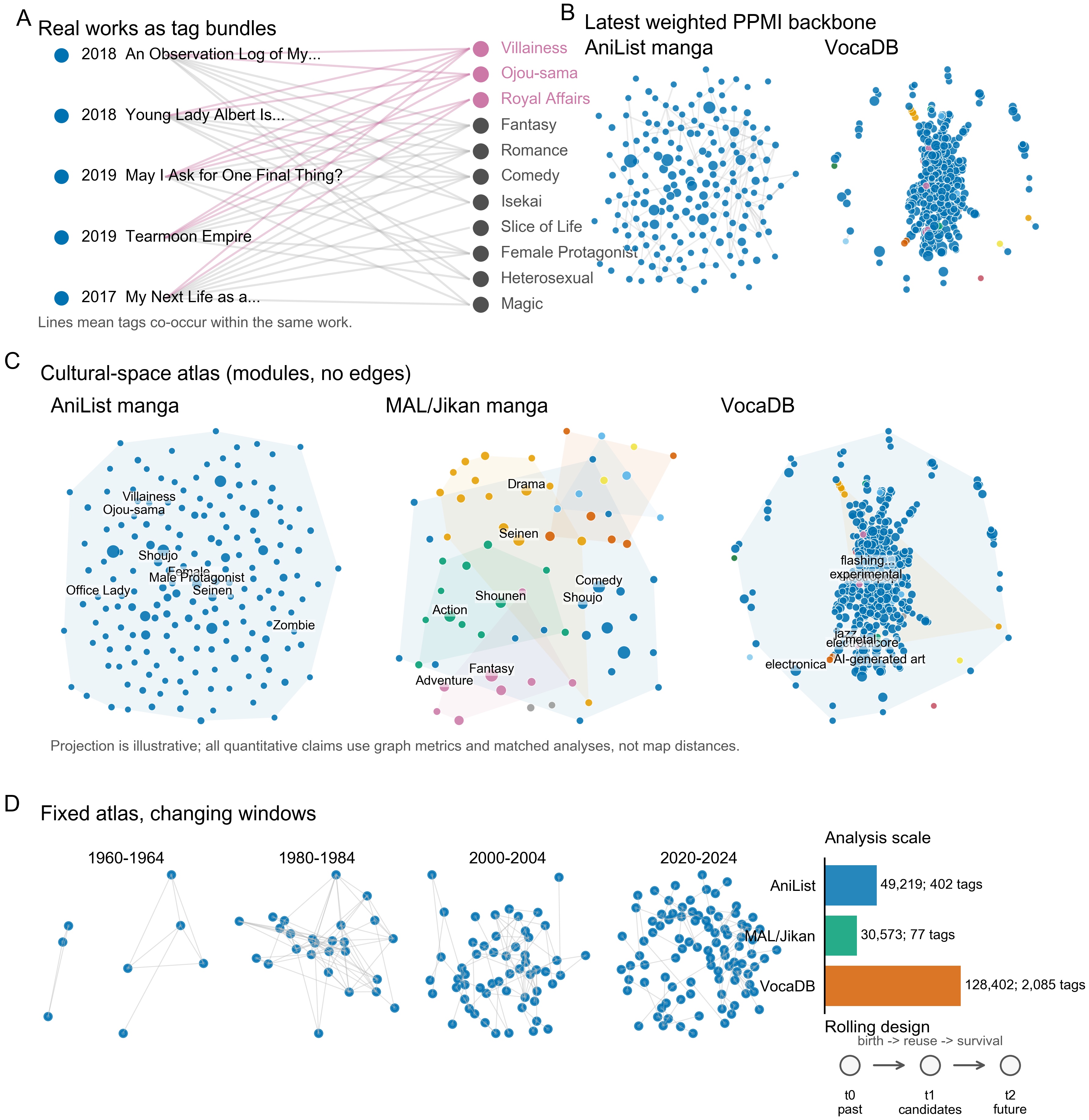
A work with a date and at least two selected tags contributes one bundle. Pairs inside that bundle become candidate associations for a time window.
Why three panels?
AniList manga gives the temporal workhorse, MAL/Jikan tests same-work ontology replication, and VocaDB checks whether the pattern travels to a different participatory music platform.
A tag pair is not important because it is merely common
t0 -> t1 -> t2
Past structure defines what is old. Current works create candidate pairs. Future windows reveal which pairs enter later grammar.
PPMI edge
Positive pairwise mutual information asks whether two tags co-occur more than expected from their marginal frequencies.
Survival
A candidate pair survives when it becomes a positive-PMI edge in t2. It is abandoned when it was reused in t1 but does not enter future grammar.
Expandable methods details
Matching controls compare survivor and abandoned pairs within period, exposure, and tag popularity strata, then add current PPMI in stricter checks. Persistence nulls compare observed future grammar with tag-composition persistence and whole-recipe bootstrapping.
The product space starts from real work bundles
Interactive panel: tag atlas search
Illustrative projection only. Search a tag, switch panels, and read support/degree on hover or tap.
Observed networks are edge-poor but association-rich
Interactive panel: null distributions and named pairs
Interpretation
Degree-preserving nulls ask: if work sizes and tag frequencies stayed the same, how much association would appear by chance? The observed system keeps fewer positive edges, but the retained edges have much stronger PPMI.
Production is structured, but it does not solve consolidation
Interactive panel: mutation kernels and choice models
Repeated attempts matter, but repetition is not destiny
Interactive panel: reuse gradients, persistence nulls, and controls
Durability rises with repeated use more cleanly than with raw PMI alone
Who survives? Locally coherent maturation, not pure periphery
Interactive panel: matched contrasts, new-tag route, and case pairs
A bounded mechanism, not a universal generator
Interactive panel: reinforcement variants and retention tradeoff
What survives strict checks, and what we dropped
Window and ontology
The repeated-attempt and selective-maturation patterns survive 3-year windows and same-work MAL/Jikan replication, but VocaDB has fewer rolling triples.
Nulls and controls
Exact bipartite swaps, tag-composition persistence, whole-recipe bootstrapping, and reinforcement controls bound the interpretation.
Boundaries
The evidence does not support a power-law PPMI law, a 1959 phase transition, a simple reinforcement solution, a pure periphery law, or a hit-prediction framing.
Negative-control catalog
A compact map of what the evidence supports
A selective-maturation mechanism
1. Selected backbone
Observed product spaces contain fewer positive associations than degree-preserving chance, but the retained associations are much stronger.
2. Structured production
New works usually inherit recognizable tag recipes and mutate them through local, modular, distant, and entrant-tag opportunities.
3. Repeated use matters
Pairs born with more repeated uses persist through a larger share of future windows across AniList, MAL/Jikan, and VocaDB.
4. Boundary
This is a mechanism map, not a solved autonomous generator or hit-prediction model. High PMI alone can be niche, most repeated pairs still disappear, and tested reinforcement variants remain incomplete.